


How Does Private Real Estate Investing Work?
Private real estate investment is defined as combining the resources of several different real estate investors to complete a large commercial transaction. The federal Securities and Exchange Commission (SEC) supervises private real estate offerings because it will involve the sale of “securities” in the form of an “investment contract.
Private real estate offerings are an incredibly powerful way for sponsors to leverage the knowledge and resources of others. At the same time, it also provides an opportunity for investors to get involved entirely passively and hassle-free!
If you are interested in learning more about private multifamily investments, please check out our complete guide here: Private Multifamily Investments.
Today’s article will be walking through the fees associated with private real estate offerings and how multifamily sponsors get paid! Whether you are interested in passive real estate investing or looking to sponsor your real estate deals, read along to examine the fees associated with private real estate offerings.
Real Estate Investment Fees
Before investing in a private real estate investment, it’s crucial to examine the “norm” in the industry to ensure you are investing with a reputable multifamily sponsor. As a passive investor, it’s essential to thoroughly analyze the multifamily offering documents and consult with a legal professional before jumping into a deal. The sponsorship group that has distributed the offering should always clearly disclose the fees associated with the private real estate investment.
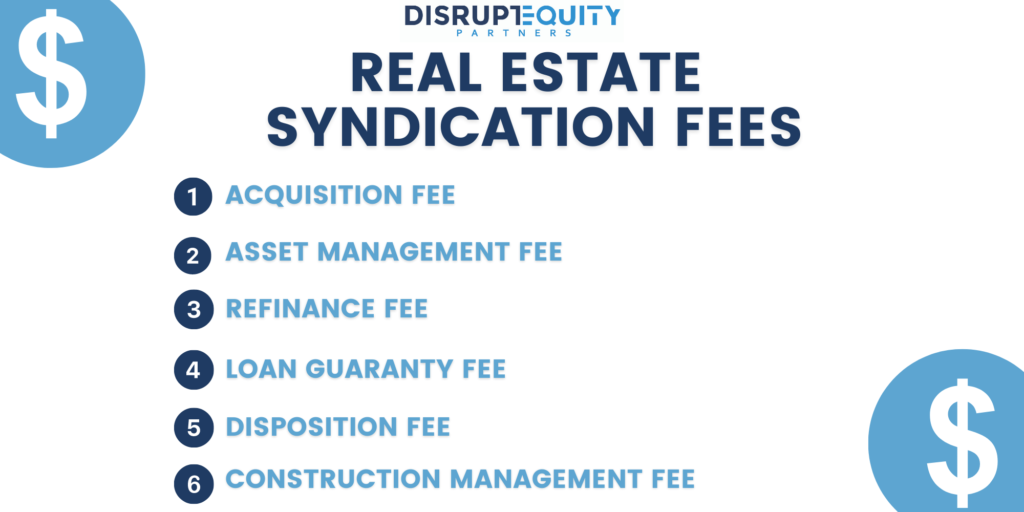
Let’s take a look at the most common fees that occur in private real estate offerings:
- Acquisition Fee
- Asset Management Fee
- Refinance Fee
- Loan Guaranty Fee
- Disposition Fee
- Construction Management Fee
Acquisition Fee
An acquisition fee in real estate serves as compensation for finding the deal and structuring the private real estate investment!
Most multifamily sponsors will charge an acquisition fee. The acquisition fee will vary from 1% to 5% of the property’s purchase price, and the percentage will depend upon the size of the deal. The larger the deal size, the higher the acquisition fee. For example, if the acquisition fee was 3% on a 10 million dollar apartment building- the multifamily sponsor will receive $300,000 at closing.
The acquisition fee is a one-time payment paid to the multifamily sponsor at the time of closing.
Asset Management Fee
The asset management fee is a continuous charge paid to the multifamily sponsor. The asset management fee serves to reimburse the multifamily sponsor for operating and managing the property during the investment.
In most cases, sponsors will charge a 1 to 3% percent asset management fee based on the gross revenue collected from the property and would be paid out either monthly or annually. In some cases, the asset management fee could be charged per apartment unit. The most common per unit asset management cost would be $200-$300 per unit annually.
Refinance Fee
Although a refinance does not always occur, a refinancing fee could be paid to the multifamily sponsor as compensation for the work required to refinance the property. In most cases, this would be .5 percent of the new loan amount obtained.
Loan Guaranty Fee
A sponsor may use a person with a high net-worth/balance sheet to sign on the loan to receive the most lucrative financing terms for the property. If this is the case, this could result in a guaranty fee.
A guaranty fee is often paid once at closing to the loan guarantor for his or her role in signing on the loan. Alternatively, the sponsor could sign the loan themselves.
A guaranty fee is typically 2-3% of the loan amount but could vary depending upon the size of the loan.
Construction Management Fee
The multifamily sponsor does not typically charge construction management fees; instead, these fees will be billed from a third-party construction management firm that is in charge of the property’s capital improvement process. The construction management fee can vary between 5-10% of the CAPEX budget and will depend on the deal’s size.
Although not common, if the multifamily sponsor has an active role in the renovation process, they may charge a building and construction management fee.
Other Ways Real Estate Sponsors Get Paid
Equity Stake
Along with fees, another way sponsors get paid is through their equity stake in the project. Real estate sponsors will get compensated in the form of equity participation in the investment. This essentially is the ownership share or equity stake in the private real estate investment!
The equity payout for real estate sponsors and investors will primarily depend on how the private real estate investment is structured.
To give you a typical example, if the investment is structured as a 70/30 straight profit split. This would mean that 70% of the property’s profit would go to the passive investors in the project and 30% to the multifamily sponsor.
For more information on real estate investment structures, check out our complete guide here. Real Estate Investment Structures- A Simple Guide
If you are interested in investing in private multifamily investments with Disrupt Equity, please fill out our investment form to be notified of our upcoming apartment investment opportunities.