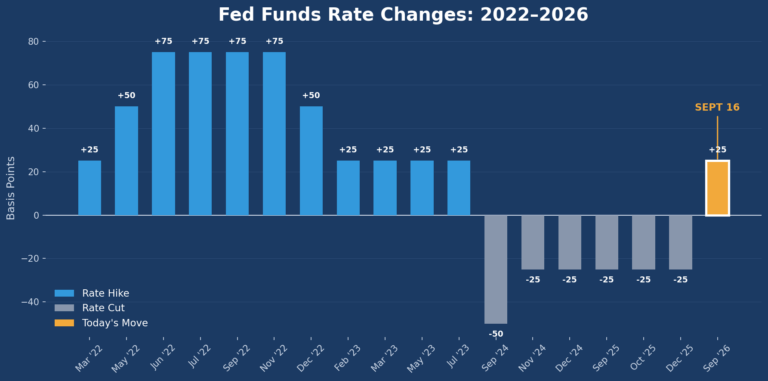
The Federal Reserve raised its benchmark rate by 25 basis points this week, moving the target range to 3.75% to 4%. It is the first increase since 2023, driven by persistent inflation from higher energy costs and the lingering effects of tariffs, and the Fed’s own projections leave room for another move before year end.
Most of the commentary on this treats it as bad news for real estate. For a large part of the market, it is. Higher rates mean higher borrowing costs, tighter underwriting, and fewer deals that pencil. But for capital looking at new development in this environment, the calculus is different: the rate environment that is squeezing out new supply is the same environment that makes the supply already in the pipeline more valuable.
Why Higher Rates Are Shrinking the Pipeline
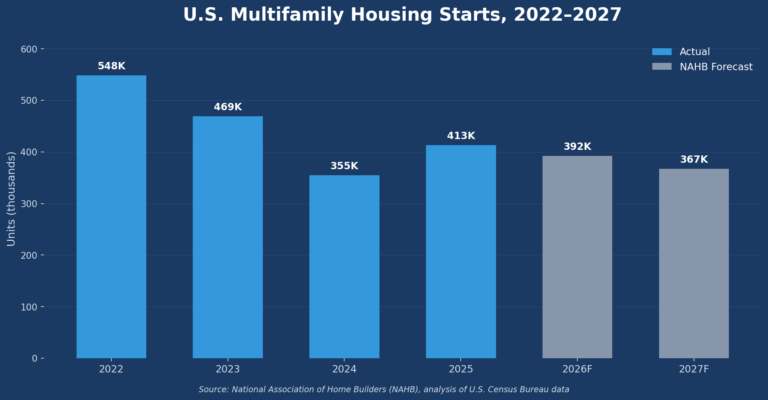
Every project that no longer pencils at 4% is a project that will not deliver in 2028 or 2029. According to the National Association of Home Builders’ analysis of Census Bureau data, multifamily starts fell from roughly 548,000 units at their 2022 peak to 355,000 in 2024, recovered to about 413,000 in 2025, and are forecast to slide back to roughly 392,000 in 2026 and 367,000 in 2027 as financing costs stay elevated. This week’s move pushes more developers toward the sidelines rather than toward groundbreaking.
That trend is a supply gap, not just a headline. Projects that are already entitled, financed, and moving forward will deliver into a market with far less competition than the wave of new units that came online between 2021 and 2023.
Where This Shows Up on the Ground
Disrupt Equity’s current offering, Hangar on Stuebner, is one of the projects already through that gate. It is a 345-unit, ground-up development on Stuebner Airline Road in the Spring and Klein submarket of Northwest Houston. Entitlements, horizontal work, and permitting are complete; the HUD 221(d)(4) firm commitment is in hand at approximately 6.25% fixed, and loan closing is anticipated in November, with vertical construction starting in the first quarter of 2027. That puts first units delivering into the exact window where the pipeline is thinnest.
How Rate Risk Gets Handled
It is worth being direct about the mechanics here: the HUD loan rate is set at closing, not before. Between now and then, the job is to make sure the deal works across a range of outcomes, so underwriting uses conservative rate assumptions and stress-tests returns against further increases rather than assuming rates fall.
Once the loan closes, the structure works in investors’ favor. HUD 221(d)(4) provides 40-year fixed-rate financing with an initial interest-only period, and from that point on, the Fed no longer touches the debt on that asset. That is a meaningful advantage over the floating-rate and short-term structures much of the market is carrying today.
The Demand Side of the Equation
Higher rates do not just slow new supply. They also keep renters renting. Every increase prices more would-be homebuyers out of ownership and slows the for-sale construction that would otherwise compete for the same households. New Class A product in a growing submarket, where an operator already owns and manages a meaningful base of existing units nearby, is well positioned to capture that demand as it builds.
A Word on Perspective
No single Fed decision should drive an investment thesis, and this deal is not underwritten on the hope that rates fall. It is underwritten to today’s environment, with anything better treated as upside. The supply data, the long-term fixed debt structure, and the delivery timing are what make the case, not a bet on where rates go from here.
Targeted returns discussed for Hangar on Stuebner are illustrative only, based on Sponsor assumptions, and are not guaranteed. This is a Regulation D, Rule 506(c) offering open to verified accredited investors only. See the PPM for complete terms, disclosures, and risk factors.